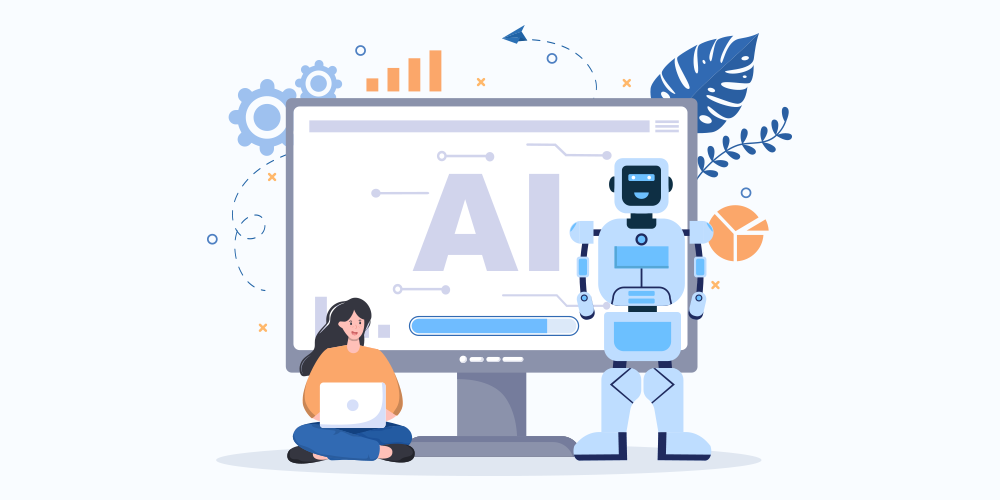
In this article, we’ll talk about AI as well as the benefits and changes it’s bringing to education.
We’ll also provide useful websites and tools that make use of AI in education.
A few educators are understandably scared of recent advancements in AI technology, especially due to the launch of OpenAI’s newest language model, ChatGPT. Students can use the platform to finish homework assignments in just two minutes.
By displaying an example of work done previously, the AI could also compose an essay written in the student’s personal style, with spelling and grammar errors, if desired, making it more authentic and making cheating nearly impossible to identify!
Table of Contents
Ban AI?
The fear of plagiarism, students not participating in assignments or having no learning, many universities across the world are implementing an all-encompassing ban on using AI.
The top French Sciences Po University Sciences Po, for example, currently “strictly forbids the use of ChatGPT or any other tool using AI” The reason is penalties, which can go as far as expulsion from the establishment or even from higher learning.
There are, naturally, several AI detection tools available. There are a variety of AI detection tools available – Originality.ai, GPTZero, Writer.com’s AI detector, to name but three. However, no tool is completely foolproof.
Talking to The Guardian on behalf of Australia, Toby Walsh, Scientia Professor of Artificial Intelligence at the University of New South Wales, told The Guardian for Australia:
“There are technological solutions available for digital watermarking. However, you could just run a different application over it to remove the watermark. This is an arms race you’re not ever going to be over, and you’ll never be able to be victorious.”
Embrace AI?
No matter whether we want to or not, in the end, AI technology is going to be a regular element of our lives. Instead of fighting it, it’s evident that educators must be able to keep up with the future, use AI to improve our teaching, and adjust the way we teach to suit.
The body that certifies qualifications, the International Baccalaureate, is using this strategy. Comparing their AI models of the language with calculators or spelling checkers, which, when utilised correctly, could add value. They have declared they will allow students to draw quotes from the work produced by ChatGPT.
The learning process will likely be drastically altered in the near future, both about the content and the skills that need to be taught, but also the method students learn.
Instead of focusing exclusively on writing output, for instance, students might be urged to work to develop relevant questions, studying how they come up with ideas, discussing group projects, as well as high-level critical thinking and communication abilities. These are all human-like activities that ChatGPT’s version of ChatGPT cannot duplicate.
Furthermore, increasing numbers of teachers are turning to AI solutions that integrate VR or online activities in their teaching strategies, which could result in many imaginative, engaging, stimulating and highly effective immersive learning experiences.
In terms of the use of VR technology, Graeme Lawrie, Director of Innovation and Outreach at Sevenoaks School, UK, recently wrote that his school was “moving away from simply ‘learning’ a subject or topic to ‘feeling’ the content.” He explained the strategy:
“allows a student to explore, to experience or to be involved in something, as if they are actually present in that environment or place.”
The benefits of AI for students
If we can get students involved in technology from an early stage, we’re likely to give them an advantage in the near future, where the use of this technology will eventually become more widespread. However, we should look at some of the ways that AI is already providing huge benefits to students:
- Examine gaps in learning: A specially-designed AI platform allows you to analyse your past performance and reveal learning gaps that could remain undetected.
- Customisation: AI is able to adapt the content for each user, resulting in an individual learning experience instead of an all-size-fits-all approach. all methods.
- Answers to questions instantly: Questions answered instantly. Your AI students will have their questions answered in a matter of minutes instead of waiting around for a human to respond. This also has the benefit of allowing shy students to inquire without the fear of being assessed.
- Rapid feedback and just-in-time learning: Students are able to get more frequent and immediate feedback right at the time of learning, if the subject remains fresh in their minds, while they’re willing to learn.
- Engagement: Learning using AI lets you play games and other learning environments that are engaging, like AR and VR, which greatly improve the motivation of students and their engagement.
- Time-saving: Using AI to come up with ideas or to structure content allows students to concentrate on higher-level skills like analysis or creative thinking.
- Increased accessibility: With intelligent data collection, customised tasks and schedules that are personalised that blur the lines between teachers, students and school administrators are able to be blurred by using AI technology. Limitations based on physical locations or language are able to be eliminated in the near future as we strive to provide accessibility to all 24/7.
- Neurodiversity: Some students who struggle with traditional settings or methods of learning excel in an AI environment.
Educational benefits
There are a variety of ways that educators are already benefiting of AI and the benefits will only increase:
- Time savings: AI can take on some of the tedious tasks that teachers are required to perform, such as record-keeping and marking. AI can also aid in streamlining the planning process, giving teachers the confidence to take on the imaginative and human-like actions needed to bring learning to a higher level.
- Concept and content generation: AI will help teachers cut down time when they create content or ideas, as well as learning objectives that teachers can examine, edit and utilise innovatively in the classroom. projects or assignments
- Student questions can be answered: the use of AI as an individual tutor benefits not just the students but also the teachers. As more questions are answered, teachers can monitor the questions they’ve been asked while working on strategies to engage students and close any gaps in their learning.
- Monitoring student performance: AI can track class attendance, submission of assignments and the performance of specific tasks to identify the areas of learning that aren’t being met or to flag concerns about behaviour. This makes it simpler for teachers to plan the right interventions promptly.
- Engaging students and motivating them: In today’s fast-paced, technologically driven world, students seek out exciting and fun ways of learning. This keeps them interested.
Use cases
Moving to some fascinating examples of use, we’ve chosen only a few examples; however, there are a myriad of innovative firms working on AI-enhanced solutions that support and improve learning for students of all ages.
- Seneca is a UK-based software for homework and revision that is so confident of its products that it promises that its students will get top marks on their exams or money or your money back!
- Thinkster Maths is a digital maths tutoring platform that makes use of AI and machine learning to visualise the way a student thinks and tailor content.
- Knewton’s Alta is designed to be used by students in higher education. This programmable courseware for learning is designed to optimise the learning and studying experience of students while working on tasks.
- Gradoscope is a platform that does not just grade papers, but also gives students invaluable feedback and information to help instructors track the progress of their students and identify learning gaps.
- VirtualSpeech is focused on the essential soft skills, including meeting, presentation and interviewing abilities. VirtualSpeech uses immersive VR technology to recreate
- InnerVoice, created by iTherapy, is an application designed to assist children with neurodivergent disorders in making connections between language and objects, as well as assist them in learning.
Conclusions
AI is evolving rapidly. It has already affected the educational system and is expected to continue to disrupt.
Teachers who remain in their positions and rely on traditional methods will be out of the loop, while those who embrace the power of AI and adopt tools and platforms that reduce the amount of time they spend on work can concentrate on the more humane and imaginative work of generating educational experiences that are truly valuable.
From the students’ viewpoint, they are expecting immediate feedback, innovative, interactive learning and gamification as a standard.
Likely, not just the way we teach, but also the content we teach will evolve as we continue to advance AI. The required skills for the next generation of workers will be more focused on the higher-level capabilities of creative thinking, critical thinking, and communication.